
A lack of water does not always mean that there is little rainfall. On many farms and in many regions, a significant part of the problem lies in how water behaves once it reaches the ground: rains can be very intense, causing water to flow rapidly across the surface, washing away fertile soil, and leaving the area before it can seep into the ground and nourish the landscape.
At the same time, dry spells are becoming longer. Climate change is intensifying these extremes, while soil degradation, vegetation loss, and changes in land use can exacerbate their effects.
In this context, retaining water on a farm It doesn’t just mean building reservoirs. It means restoring the landscape’s ability to receive, slow down, infiltrate, store, and gradually release water.
This is the logic of a sponge landscape: a landscape capable of absorbing and retaining some of the excess rainfall and keeping it available during dry periods. In addition to increasing water availability, this approach helps reduce erosion, improve soil quality, strengthen ecosystems, and increase resilience to floods, droughts, and wildfires.
What is a sponge landscape?
A sponge landscape is a landscape designed or restored to regain its ability to manage water naturally: by slowing runoff, promoting infiltration, temporarily retaining water, and maintaining moisture in the soil and vegetation.
The goal is not to prevent the water from continuing its course, but to keep it from leaving the landscape too quickly and with too much energy.
The soil, vegetation, organic matter, topography, and certain retention structures can function together as a living hydrological infrastructure.
A sponge landscape can, therefore, combine different strategies depending on the location: stormwater harvesting, soil improvement, revegetation, management of paths and runoff, temporary retention areas, and other interventions tailored to the topography and characteristics of the land.
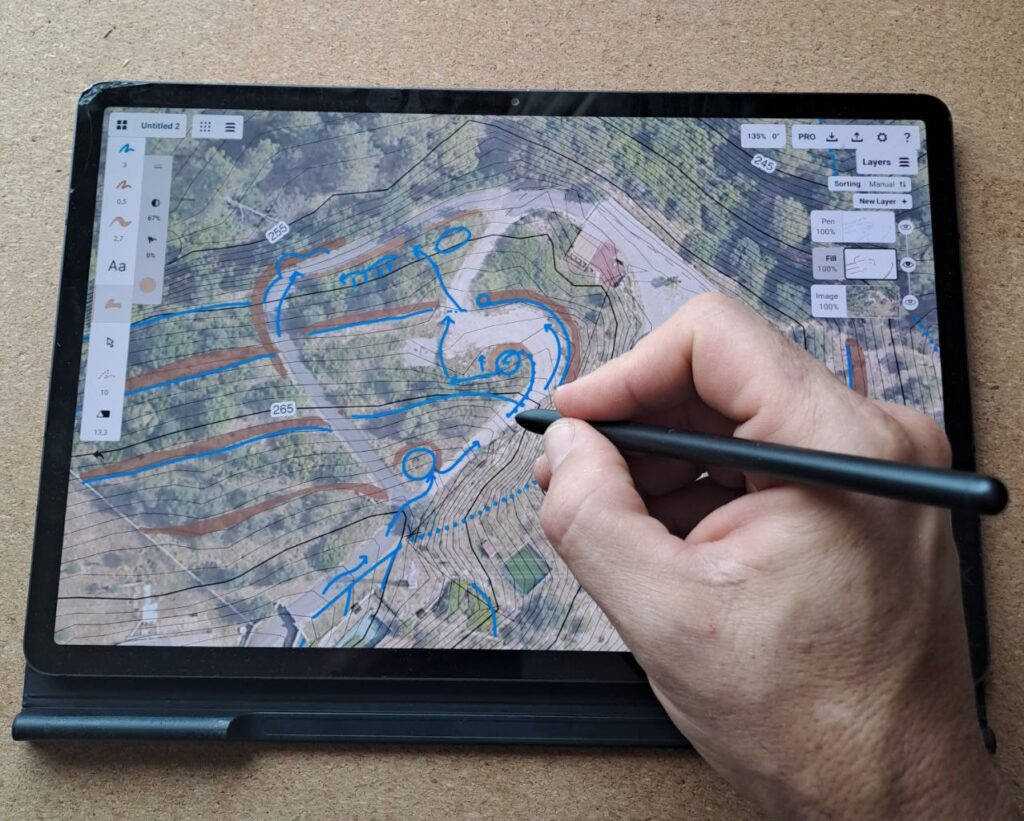
Why might a farm lose a large portion of the water it receives?
When land is degraded, bare, or compacted, it can absorb much less water than living, well-structured soil.
The rain then quickly turns into surface runoff. As the water becomes concentrated and gains speed, it can carry away soil particles, organic matter, and nutrients, creating ruts, gullies, and eroded areas.
As a result, a farm may experience flooding or heavy runoff during a storm and, just a few weeks later, have dry soil and vegetation suffering from water stress.
The problem isn’t just how much rain the area receives, but how much water it is able to retain, infiltrate, and keep available.
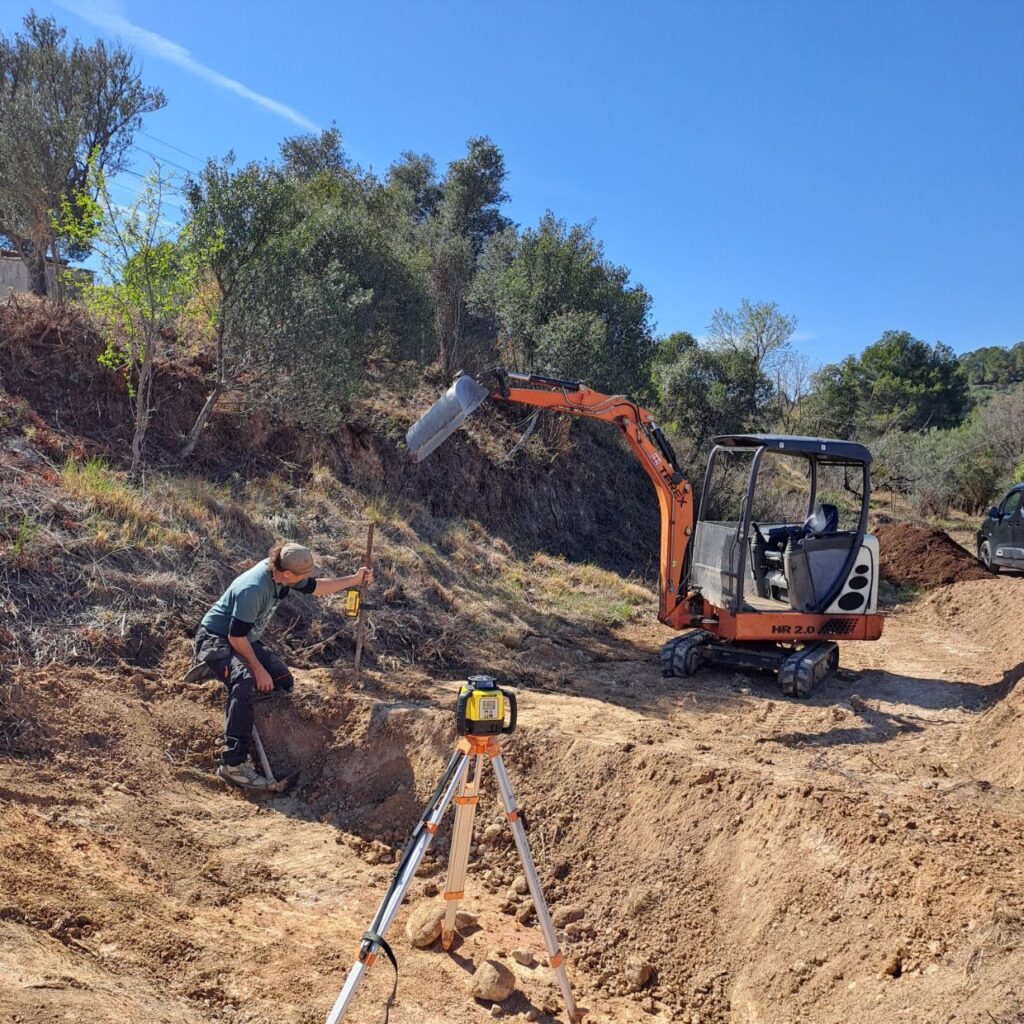
Before Retaining Water on a Farm: Understanding How Water Moves
Before carrying out earthwork or installing infrastructure, it is essential to understand the site’s hydrological behavior.
Slope, aspect, soil, vegetation, geology, roads, buildings, and compacted surfaces all affect the flow of water. It is also important to understand the relationship between what happens upstream and downstream.
A hydrological analysis makes it possible to identify where water enters, where it accumulates, where it gains speed, which areas are subject to erosion, where moisture remains, and which locations offer favorable conditions for infiltration or temporary retention.
This analysis is essential for preventing the transfer of a problem from one area to another and for identifying the best opportunities for regeneration.
Creating a Sponge Landscape: Slow Down, Distribute, Infiltrate, and Store
A sponge landscape does not depend on a single piece of infrastructure. Its functionality arises from the combination of different elements and processes.
At certain points, it will be important to to slow down water to reduce its erosive power. In others, distribute it to prevent it from concentrating on a single route. Where conditions permit, we can promote infiltration and the replenishment of groundwater reserves. In certain areas, it may be advisable temporarily retain water, while during heavy downpours it will be necessary to channel it safely.
The goal is to restore some of the landscape’s ability to function as a sponge: to absorb water when it is abundant and keep it available for a longer period of time.
Improve the soil to retain more water
Soil is one of the main water reservoirs in a landscape.
Soil with good structure, organic matter, and vegetation cover can infiltrate and retain water very differently from bare or compacted soil. Improving its structure and increasing its water-holding capacity allows a greater portion of the rainfall to remain available to vegetation.
Revegetation, soil protection, increasing organic matter, and other regeneration practices can be part of a sponge landscape strategy.
These actions also have effects that extend beyond water: they promote biodiversity, improve soil fertility and structure, and help maintain healthier and more resilient ecosystems.
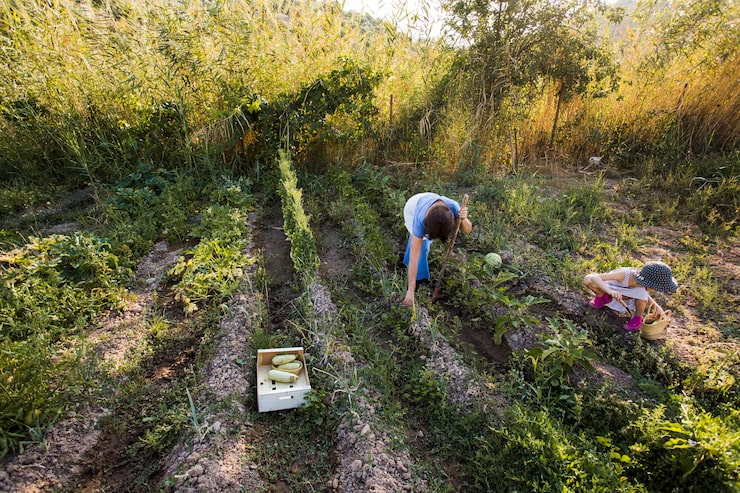

Make use of existing roads and other infrastructure
Impermeable or compacted surfaces can quickly become runoff pathways.
Roads, for example, can collect large amounts of water and cause erosion at certain points. Roofs and patios can also generate significant runoff during heavy rain events.
These areas can be integrated into a broader strategy for stormwater collection and management. Some of the water can be stored in reservoirs for use during dry periods, while excess water can be channeled to areas where it can be slowed down, allowed to infiltrate, or temporarily retained.
Thus, a surface that previously accelerated water runoff can become part of a more functional hydrological network.
Storing Water for Dry Seasons
The landscape’s ability to infiltrate and retain water is essential, but in certain locations, it will also be necessary to have storage in reservoirs, ponds, or other infrastructure.
The choice will depend on rainfall, the catchment area, water needs, soil, topography, and site characteristics.
Storage allows us to conserve some of the water from wet periods for use when rainfall is scarce. But when water is retained and infiltrates the landscape itself, its benefits can extend far beyond that: it remains available for longer to the soil, vegetation, and livestock; it replenishes groundwater reserves; and it may even reappear later in other parts of the area—for example, by increasing the flow of a spring or the water level of a well.
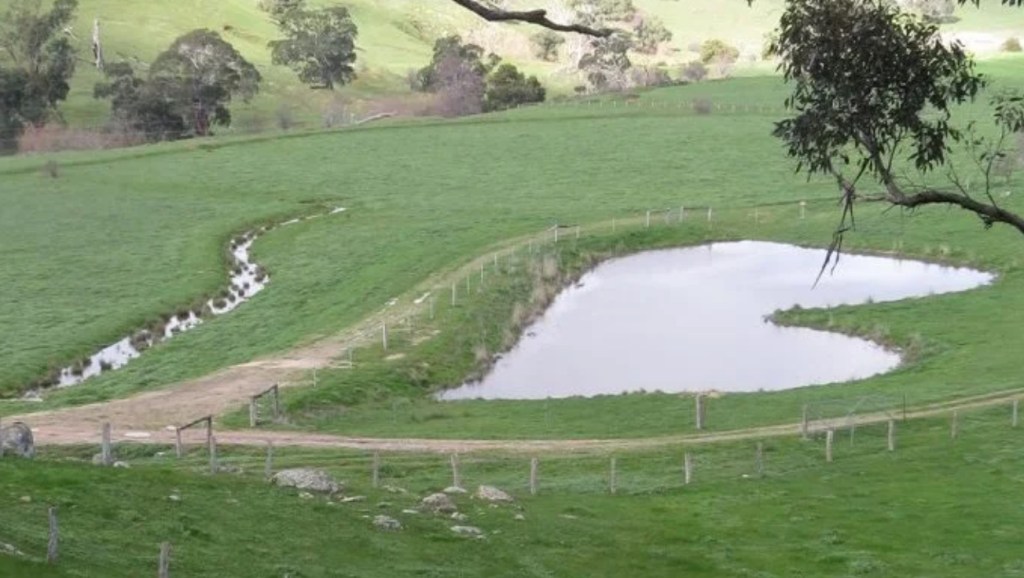
In a context of longer droughts and increasingly erratic rainfall, increasing this storage capacity—both within the landscape and through infrastructure—strengthens the self-sufficiency and resilience of the farm and the region.
It is necessary to study where the water will come from, what the catchment area is, how much water can be stored, what the soil characteristics are, and how the system will function during periods of heavy rain. In addition, the ponds can be part of a larger network in which water gradually passes through different components before continuing on its way.
In this way, a single rainfall event can create multiple opportunities for infiltration.
A more porous landscape is also a more resilient landscape
Restoring a landscape’s ability to manage water has effects that go far beyond simply providing water for irrigation.
When water remains in the soil and vegetation for longer periods, ecosystems can maintain better moisture conditions during dry periods. This can reduce water stress in vegetation and help decrease vulnerability to fires.
During periods of heavy rain, slowing down and spreading out runoff can reduce erosion and decrease the speed and energy with which water reaches low-lying areas, helping to reduce the risk of flooding.
In this way, restoring the natural water cycle also becomes a climate adaptation strategy: we make better use of wet periods to increase resilience against dry periods and reduce the impacts of extreme events.
Hydrological Consulting - Plan Before Taking Action
Turning a property into a “sponge landscape” doesn’t mean adding as much infrastructure as possible. It means first understanding how the site works and figuring out where it makes sense to intervene.
A hydrological assessment and design can identify the main water pathways, runoff and erosion problems, opportunities for infiltration, storage needs, and potential restoration measures.
Based on this assessment, various strategies can be combined: soil and vegetation improvement; rainwater capture and conveyance along roads; retention features such as infiltration ditches or small, temporary biodiversity ponds; storage in the form of ponds or wetlands; and other interventions tailored to each site.
The goal is to design with water and the landscape, not against them.
Turning Rain into an Opportunity to Regenerate the Land
A sponge landscape takes advantage of times of abundance to prepare for times of scarcity.
When we manage to slow runoff, promote infiltration, protect the soil, and store some of the water, each rainfall event can help maintain moisture, regenerate the soil, and strengthen ecosystems.
Water retention on a farm is, therefore, much more than simply preventing water loss. It involves restoring hydrological functions, increasing the resilience of the land, and creating landscapes that are better able to withstand droughts, torrential rains, fires, and floods.
At La Casa Integral, we approach hydrological design and consulting from this systemic perspective, studying the behavior of water and its relationships with the soil, vegetation, topography, and the landscape to develop strategies for sponge landscapes tailored to each specific location.