
In a previous post, I applied three principles of permaculture to my diet as part of a series of posts on holistic health that I hope to write. Today I want to look at a few more principles.
Get a Return
Multi-functional and grow your own food
“You can’t work on an empty stomach,” says the description of this principle on David Holmgren’s website. Today, I believe we need to go beyond simply feeding ourselves—beyond just eating. Paying attention to the amounts of nutrients in the foods we consume, and knowing and understanding the bacterial colonies that are actually present in our stomachs and digestive systems, will give us a good indication of whether we’re truly “getting a return” from the simple act of “eating.” “Empty” foods will likely leave us with “waste”—highly processed junk—which may be the opposite of the yield we seek in every permaculture design.
There is more and more information about the microbiome and its importance to our overall health (yes, including our mental and emotional health—it’s often referred to as our “second brain”). So if we have to meet our basic need for sustenance, we might as well take advantage of the opportunity to kill multiple birds with one stone—and do it right in more ways than one. In the daily activity of “having to” eat (in and of itself), we can combine the following functions:
- Balance the “bad guys” in your microbiome and repopulate it with “good guys” by following a balanced diet based on organic whole foods (regenerate your soil!) to achieve true nutrition and optimal levels of health and energy. Learn about prebiotics and probiotics (especially to counteract the use of antibiotics when they’re necessary) and cut out refined sugar.
- Treat yourself to some time outdoors, growing much of that recommended, nutritious diet of organic, whole, and regenerative foods. It will give you:
- A mental boost: time to slow down and connect with nature; it has been shown that connecting with beneficial soil bacteria helps prevent and alleviate depression and anxiety, and in community gardens, you also build human connections…
- a physical boost: fresh air, “agro-fitness” (watch your posture!), grounding…
- A greater awareness of natural cycles, which is very helpful in designing a Holistic Diet. Annual plants are great, but just as in nature itself, we see that perennial plants and products from forest gardens offer greater durability (and more nutrients). On top of that, they’ll require less maintenance, so you’ll gain the added benefit of having more time for contemplation and meditation—or for spending time with your loved ones.
Carbohydrates are necessary, so think about what you’re going to eat to replace grains in your diet—unless you live in a region where rice is traditionally grown. Many grains are transported over long distances, and their cultivation isn’t exactly environmentally friendly (often involving monocultures worked with heavy machinery). Wheat is also the plant that has displaced the most species in human history—we could even call it the most invasive. The Romans spread wheat throughout their empire to feed the citizens of Rome. In Spain, the Quercus Ilex (the acorn-based diet!) was displaced to make way for wheat, olives, and grapevines. They colonized the cultural diet of our region!
It’s not just that gluten is becoming a problem for human health (the fact that the plant is evolving to become more “toxic”—it’s protecting itself with more antinutrients in its husk, to deter pests and herbicide attacks—years of abuse by Roundup and similar products)—but there’s also the fact that its (mono-)culture is among the crops that most frequently damage the fertile topsoil so essential to our livelihood and the environment in general.
Can you eat rice where you live? Potatoes? Sweet potatoes? Ñameras? Lentils or chickpeas? Any regenerative carb projects nearby? If you live in an apartment, maybe you can grow a small herb garden on your windowsill or sprout some seeds or nuts—anything green will boost your immune system!
Having reliable access to healthy food is an essential part of your resilience plan. Hence Bill Mollison’s words:

So… Get that return and stack up the benefits: time outdoors and exercise, connection with nature and people, real nutrition and optimal energy levels, a higher level of resilience in the face of various future scenarios (climatic, economic, political…), you could even sell what you have left over, so financial income or a lot of social capital can also be generated, simply by… having to eat!
Stop Producing Waste
Use the whole animal
We had a fantastic restaurant near our home in Port de Pollença called Terrae. They serve grass-fed beef (regenerative beef) on the menu, but they can’t tell you exactly which cut you’ll get on your plate. They buy the whole animal when it’s slaughtered and prepare whatever’s on hand when they open the freezer door—it’s always delicious! No picking and choosing—just steaks! Because, according to their philosophy—which is very much in line with the “Zero Waste” principle—that would be a waste and a lack of respect for the animal (please, let’s not be disrespectful to one another when discussing whether or not to eat meat). Whenever we can, we’ll eat at Terrae and say hello to the chef, David!
There are some examples of how this principle is applied on David Holmgren’s website; what we’d particularly like to highlight under this principle is the use of bones. Bone broth is a fantastic superfood, but bones are often thrown away. Did you also have a grandmother who put a bone in the soup? And did that soup have those greasy bubbles on the surface? Well, that’s the good part—it’s super nutritious!

Bone broth boosts immunity, reduces inflammation, alleviates symptoms of the common cold and bronchitis, aids in weight loss and hydration, gelatin has anti-aging and cell-protective properties, and it also helps regulate stomach acid production—and there are many more benefits, not to mention that it’s easy on the wallet.
Bone broth is very inexpensive to make, uses a “waste” product, and is good for you. So if you’d like to try it, find your local regenerative meat supplier on this map from the Iberian Regenerative Agriculture Association (if you’re in Spain), and on top of that, you’ll be supporting your local economy, thereby increasing your local resilience (let’s do everything we can to make sure those local farmers don’t give up and disappear!). Enjoy!

Embrace Change and Respond Creatively to It
Eat according to the season, even if the weather changes
David Holmgren’s website discusses “inevitable change.” There’s no doubt that it’s coming… and you may find comfort in the Deep Adaptation approach (a global movement based on a report by Jem Bendell that states there is no longer any possibility of mitigating climate change). But if we want to stay focused on day-to-day life here and now, we can also observe the inevitable natural changes throughout the annual cycle—from spring to summer, through fall and winter. Plants grow and die; others take their place.
If we look around, we often have something to eat right there! Perhaps it would be wise to develop some skills and learn about“the food we walk on” (a phrase coined by Josep Pamies, an advocate ofcivil disobedience, and his organization“Dulce Revolución”) every day.
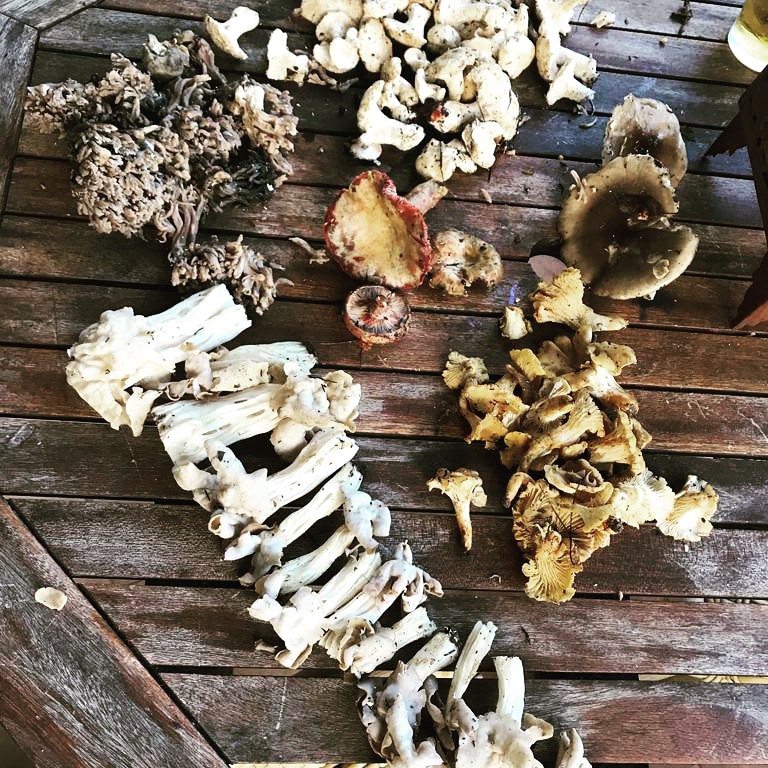
Here near Can Cel, we have mushrooms, chestnuts, berries, all kinds of wild greens, rosemary and thyme, flowers, Jerusalem artichokes, fennel, asparagus, wild chard, wild garlic, borage, you can even nibble on young pine needles for vitamin C… everything changes with the seasons. A creative cook can work magic and bring beautiful dishes to the table. And, once again, it’s a great way to save money for the household budget!
Check to see if there’s a workshop in your area, or use the Plants for a Future database to find out a plant’s edibility rating—it’s a great resource, and it’s free! (Although it would be great to support the cause with a donation if you can.) But it doesn’t hurt to take some precautions; the David Suzuki Foundation has a list of recommendations. We’ve translated it from English for you here:
Tips for foraging for food:
- Do you know enough about the plant to forage it? Avoid poisonous plants: even experienced foragers can make mistakes. Buy an identification guide to help you triple-check the species of plants or mushrooms you find, but if you’re just starting out, be sure to go with an expert. If you’re not sure, don’t eat it.
- Do not take plants that are endangered. Always check before collecting.
- Take only what you need.
- Obey the signs. Pick up your trash away from parks and nature reserves. It is illegal to pick up trash in some parks. You may be fined.
- Be careful around areas that have been sprayed with pesticides or herbicides. If you’re foraging in ditches, for example, look for signs of spraying (brown vegetation) or call city hall to check.
- Follow the trail signs, tread carefully, and try not to trample on natural areas.
- Learn about animal tracks, droppings, and other signs to find out who else might be foraging in the area.
- Sign up for a workshop and learn from the experts.
- To increase your chances of seeing wildlife in its natural habitat, leave your dog at home.
- Start looking for food in your garden. Did you know that dandelion leaves make an excellent salad?
- Be careful not to trespass on private property. Not sure? Check a municipal map or ask the owner directly. (Maybe say thank you with a wild blueberry cake?)
- Learn about harvesting with consent. Consider whether your relationship with the land is reciprocal. Give thanks. Some of the teachings from First Nations that you may encounter include checking your intentions, harvesting in daylight, coming with good feelings, speaking aloud to the plant, and asking for permission. Are you curious? Learn about the territory you’re in, and don’t hesitate to contact a local tribe or attend a workshop with an elder.
As for climate change… you might want to prepare yourself and take a look at the warmer climates near you—see what kind of edible vegetation and wildlife they have… and start eating prickly pears or pithayas, for example! Creatively… by responding to all kinds of inevitable changes, we can come up with much more ingenious solutions. It becomes second nature once we exercise that muscle!
Recommended Reading
We’re only half human—a little more than half of the organisms that make up our bodies are… microbes! The human microbiome is one of our systems; some sources have already called it another organ, and many refer to it as our “second brain.” Want to learn more about it? We recommend the book *Is It the Microbiota, You Idiot? * or this article to start delving into the world of “the bugs” we carry inside us—and on top of that… : Microbiome: The “New Organ” of the Human Body That We Share with Most Other Living Beings (eldiario.es)
Antidepressant microbes in the soil!
Drinking bone broth: Is it good for you, or is it just a fad?
A word of caution to wrap up: if you notice that your body is reacting strangely (for you) to any changes you make to your diet, we recommend that you seek out a health expert in your area to guide you. We have firsthand experience with this process, having worked with a nurse, Carmen Dana—an expert in Psychoneuroimmunoendocrinology (PNIE)—to develop and implement a personalized protocol for reducing candida : a new paradigm (neuro-class.com)
Well, on that note, we’ll say goodbye for now. Cheers!