
The world is orderly. We might ask ourselves, “Even in the (apparent) chaos?”
Wherever we look, there will be elements that are interconnected, whether it’s the Amazon Rainforest, New Delhi, the Taiga, the Great Barrier Reef, macroeconomics, or a Bayer laboratory.
What is the difference between them?
The criteria by which these elements are ordered in relation to one another, the ultimate goal of that system, and the rules that govern it.
According to NESI’s Master’s Program in New Economics, DESIGN is behind 80% of the products and services currently offered worldwide.
This means that there is a conscious PROCESS of SETTING GOALS, OBSERVING, ANALYZING, DECIDING, and ESTABLISHING AN ORDER AMONG ELEMENTS (DESIGNING), and then IMPLEMENTING the design.

The values, criteria, and principles that guide the people going through this 4- to 5-phase design process are what shape the culture in which we live.
That is why it is so important to develop new design capabilities inspired by the framework of Systems Thinking.
Permaculture establishes Ethical Principles and Design Principles based on the Natural Patterns of Perennial Ecosystems and cultures rooted in their territory.
Drawing inspiration from the

Since then, we have seen many phases of redesign of the very concept of permaculture.
As the design process indicates, everything must be
Then, once we’ve implemented the design, we EVALUATE whether it has met the objectives—that is, we OBSERVE it again , VALIDATE or CHECK whether the design has actually worked, ANALYZE, DECIDE, AND DESIGN the next stage if it has. In other words, we go through the Design Process again to adjust our system; perhaps our objectives change, and our resources and constraints will certainly change—and so we are continually designing.
There are several design frameworks or structures to help us systematically work through the steps of the design process.
Some come from industrial design, such as
All of these tools help us cover the four phases we want to see in every permaculture design: OBSERVE – ANALYZE – DESIGN – IMPLEMENT (and then we repeat the cycle).
We design within our context—in harmony with the place, the people, and their resources and limitations.
We seek to meet our
Whether they are the seeds in a sunflower head, the subway map of a megacity, the Paraná Delta, a mushroom that appeared overnight, or the proportions of the Eiffel Tower, they are all variations or fractals of natural patterns, and each has its own function.
In a design process, having a connection to—or a certain proficiency in—the language of these patterns is a significant asset.
We see, for example
If you see how important design is in our lives, and if you’re drawn to the idea of engaging in a design process guided by criteria, values, and principles that improve our daily lives and those of our communities—if you truly want to design permaculture and regenerative cultures— you might be interested in our online Permaculture Design Certification (CDP), #SABERES for a Possible Future, which begins with a new learning community every September.
Learn more here:
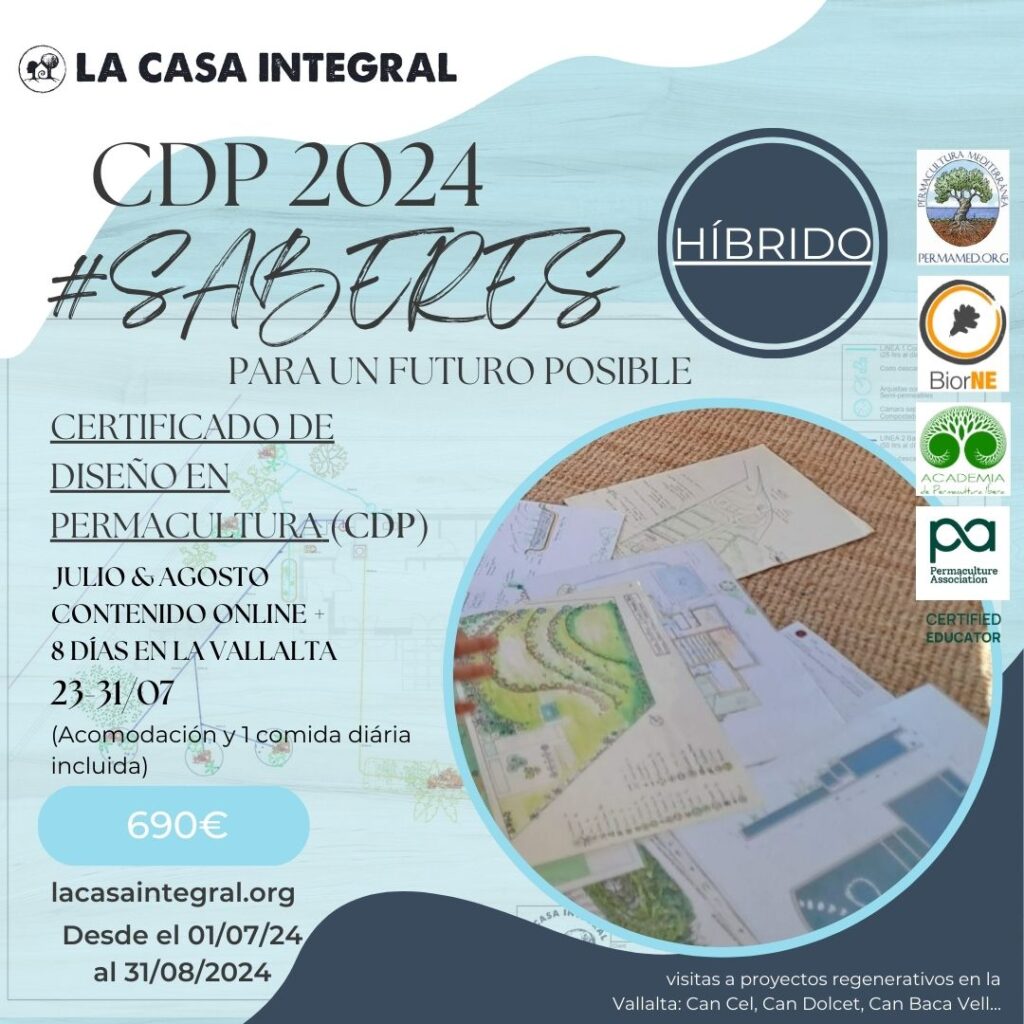
We’ll also be offering a hybrid CDP starting in the summer of 2024, featuring a residential program and visits to regenerative projects in Vallalta, our home in the Maresme region of the province of Barcelona, near the Costa Brava.
All the details here:
If you’d like to stay up to date on our activities open to the public—whether in person or online—as well as updates on the development of our suburban demonstration site, Can Cel, we invite you to check out our social media profiles:
The Integral Community: Telegram Channel with Chat
La Casa Integral (@lacasaintegral) • Instagram
And of course, we invite you to bring your own designs to life—no matter how small—and share your experience with us on the platforms we’ve mentioned here.
If you’d like, we can even provide professional guidance for your home design or other design projects—whether through a personalized, custom service from our